
Storefront
Product categories, listing pages, details, offers, and responsive shopping experience.
Online Store & Catalogue System
An e-commerce website direction for product catalogues, categories, carts, orders, enquiries, admin panels, and online selling workflows.
Store
Products, categories, offers, and customer-friendly pages.
Orders
Cart, checkout direction, enquiry, and admin flow.
Manage
Product updates, stock direction, and reporting options.
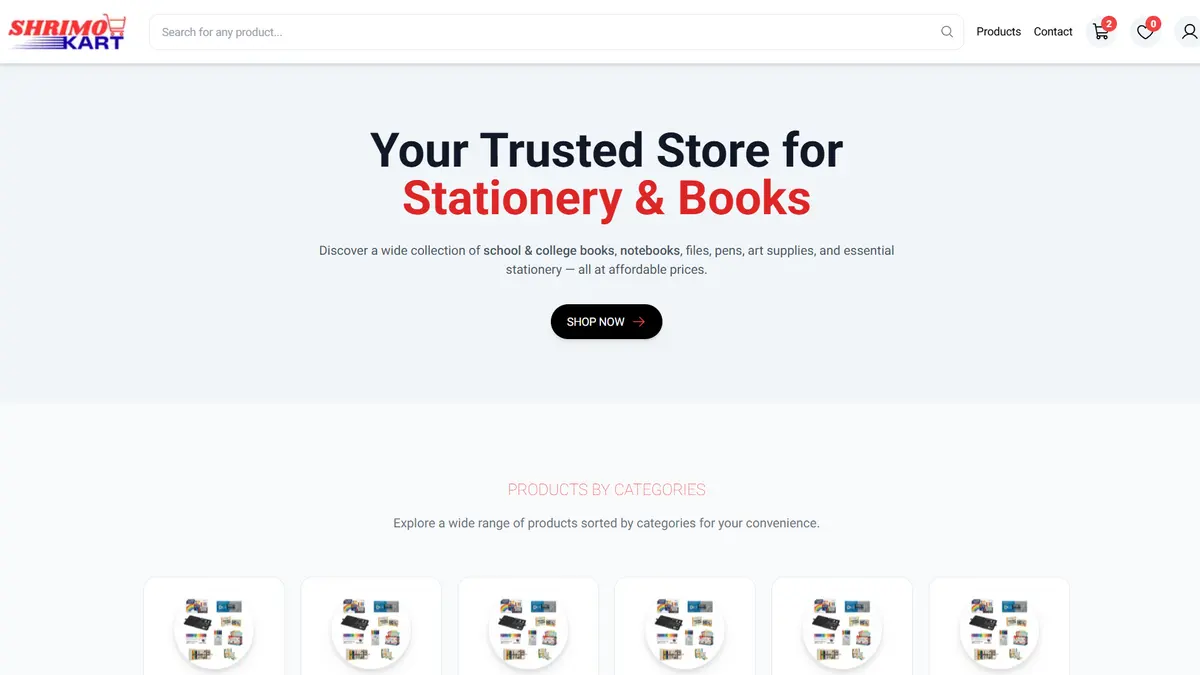
Commerce Platform
A good e-commerce website should make products easy to browse, details easy to understand, and orders or enquiries easy to complete. We plan the storefront and admin workflow together.
Useful for
Retail businesses
D2C brands
Local stores moving online
Catalogue and order-based businesses
Core modules
Each product page is linked with related services and industries so visitors can move from idea to implementation without confusion.
Product categories, listing pages, details, offers, and responsive shopping experience.
Products, categories, orders, users, stock direction, and content management.
Cart, checkout direction, enquiry flow, payment integration planning, and order status.
Product pages, category pages, and search-friendly structure for discovery.
Product flow
We start with the smallest useful version, then improve modules once the workflow is clearer.
We define product types, categories, pricing, images, and order requirements.
We plan browsing, product details, cart, checkout, and enquiry flow.
We develop storefront and admin modules with practical workflows.
We test orders, forms, products, and important customer paths.
Product detail
The store needs a complete journey from product discovery to order or enquiry, with clear management for the business team.
Product detail
Some stores need online payments, some need enquiry-based orders, and some need catalogues with WhatsApp flow. The build should match the model.
Competitor benchmark
This page is structured around the live-search benchmark for ecommerce website development company India: product clarity, workflow depth, risk reduction, integration options, and measurable business outcomes.
Top ecommerce pages explain catalogue, product pages, cart, checkout, payment, shipping, order management, offers, and customer communication.
Strong competitors compare Shopify, WooCommerce, Magento, and custom builds while explaining payment gateways, shipping partners, inventory, and migration.
Winning pages discuss mobile performance, product SEO, schema, tracking, abandoned cart recovery, and speed because ecommerce pages must convert and rank.
Scope planning
A strong product page should help buyers understand what can launch first, what can wait, and what becomes useful after real users start using the system.
Catalogue
Product pages
Cart/checkout
Payment gateway
Shipping integration
Coupons
Order dashboard
Product SEO
Marketplace flow
ERP/inventory sync
Mobile app
Advanced analytics
Use cases
Retailers
Manufacturers
D2C brands
Local stores
Risk control
Secure checkout
Payment testing
Inventory rules
Performance monitoring
Measurement
Conversion rate
Checkout completion
Cart abandonment
Organic product clicks
Repeat orders
Implementation readiness
Before writing code, we clarify users, permissions, reports, integrations, data ownership, launch support, and the smallest version that can create value.
We document roles, screens, forms, approval steps, dashboards, and the real-world process this product must support.
We define who can create, edit, approve, export, delete, and view sensitive records before the product goes live.
We identify payment, WhatsApp, email, analytics, accounting, inventory, CRM, LMS, HR, or third-party systems needed for the product.
We plan deployment, testing, training, maintenance, backups, and the first improvement cycle after users begin using the product.
References
These references are included to improve trust and help buyers understand standards, search visibility, compliance, or platform expectations connected to this product type.
Related services
These services explain the design, development, SEO, deployment, or support work usually needed for this type of product.
Website and marketing support
Product pages should not be isolated. These supporting pages help visitors connect software, websites, SEO, AEO, GEO, digital marketing, and local visibility without creating keyword conflicts.
Related industries
Product planning becomes stronger when it reflects the workflows and expectations of the target industry.
Explore more products
These related products help visitors discover connected systems instead of reaching a dead end.
Project enquiry
Tell us who will use the product, what workflow it should support, and what version you want to launch first.
Prefer direct contact?
FAQs
Short answers about scope, customization, launch, and how the product can fit your business.
E-commerce Website is used as a practical software or website foundation for teams that want to digitize a real business workflow. It can support enquiry collection, role-based access, records, reports, dashboards, and customer or staff-facing actions depending on the final scope.
Yes. E-commerce Website can be customized around your industry, users, branding, forms, modules, dashboards, integrations, and approval flow. We treat the product page as a strong starting direction, then shape the final version around your real process.
Yes. We usually recommend launching the smallest useful version first. For example, the first release can include the most important screens, forms, admin controls, and reports, then advanced modules can be added after real users start using it.
A ready-made SaaS tool is faster to start but may force your team to follow fixed workflows. A custom E-commerce Website build can match your process, data ownership needs, branding, integrations, permissions, and future roadmap more closely.
We need to know who will use it, what records or content it should manage, what actions users must complete, which reports matter, what integrations are required, and what version should launch first.
Yes. We can plan owner, admin, staff, manager, customer, student, parent, doctor, agent, or other role types depending on the product. Permission planning is important before launch so sensitive data and actions stay controlled.
Yes. Depending on the product type, it can connect with payment gateways, WhatsApp links or APIs, email notifications, analytics, CRM, accounting tools, inventory systems, LMS modules, HR systems, or other third-party services.
Yes. We can help with bug fixes, updates, backups, deployment support, feature improvements, SEO checks, analytics review, and ongoing maintenance after launch.
Yes. The product should be designed for mobile, tablet, and desktop usage. For many businesses, mobile access is essential because staff, customers, parents, patients, agents, or owners may use the product away from a desk.
Success should be measured by real outcomes such as enquiries, saved time, fewer manual errors, faster follow-ups, better reporting, higher form completion, improved customer experience, and adoption by the people who use the product daily.
NEXT STEP
Tell us about your users, workflow, and current process. We will help you shape the right product scope.